01
Decentralization
Favoring political and social arrangements in which authority is dispersed rather than concentrated in distant hierarchies.
 A Rep My Block project
Building a visible, organized anarchist caucus inside Democratic Party institutions—and connecting activists with the history, ideas, and organizations of the anarchist tradition.
Our objective is straightforward: every left tendency should have a recognized caucus within state Democratic Party institutions across all 50 states.
The democratic left contains many traditions. Socialists, social democrats, Greens, progressives, communists, anarchists, pirates, and others do not share one ideology—and they should not need to pretend that they do.
The Anarchist Caucus exists so anarchists can participate under their own political identity, organize openly, contribute their perspective, and work alongside other tendencies where common goals exist.
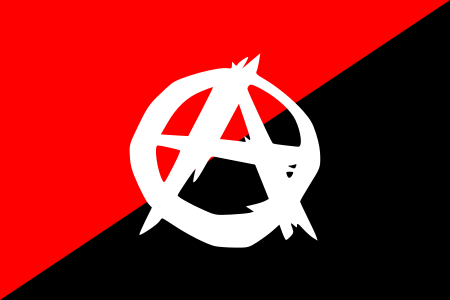
Anarchism is a social movement that seeks liberation from oppressive systems of control including but not limited to the state, governmentalism, capitalism, racism, sexism, ableism, speciesism, and religion. Anarchists advocate a self-managed, classless, stateless society without borders, bosses, or rulers where everyone takes collective responsibility for the health and prosperity of themselves and the environment.
Anarchism is a broad family of traditions rather than a single doctrine. Across those traditions, several recurring ideas help explain the political vocabulary.
Favoring political and social arrangements in which authority is dispersed rather than concentrated in distant hierarchies.
People cooperating directly to meet shared needs, build solidarity, and create durable institutions of reciprocal support.
Emphasizing freely chosen cooperation and skepticism toward relationships maintained primarily through coercion.
Creating structures in which people affected by decisions can participate meaningfully in making those decisions.
Questioning entrenched hierarchies and demanding that concentrations of power justify themselves to the people they affect.
Recognizing that anarchism includes differing schools, strategies, histories, and debates rather than one fixed political line.
The existing caucus page points visitors toward organizations, publishers, archives, and reference material. This version makes those resources easier to explore.
The caucus project connects ideological identity with participation in the institutions that make up the Democratic Party.